


Runner-Up — Team 4365 | Takehiro Muramatsu (Japan)
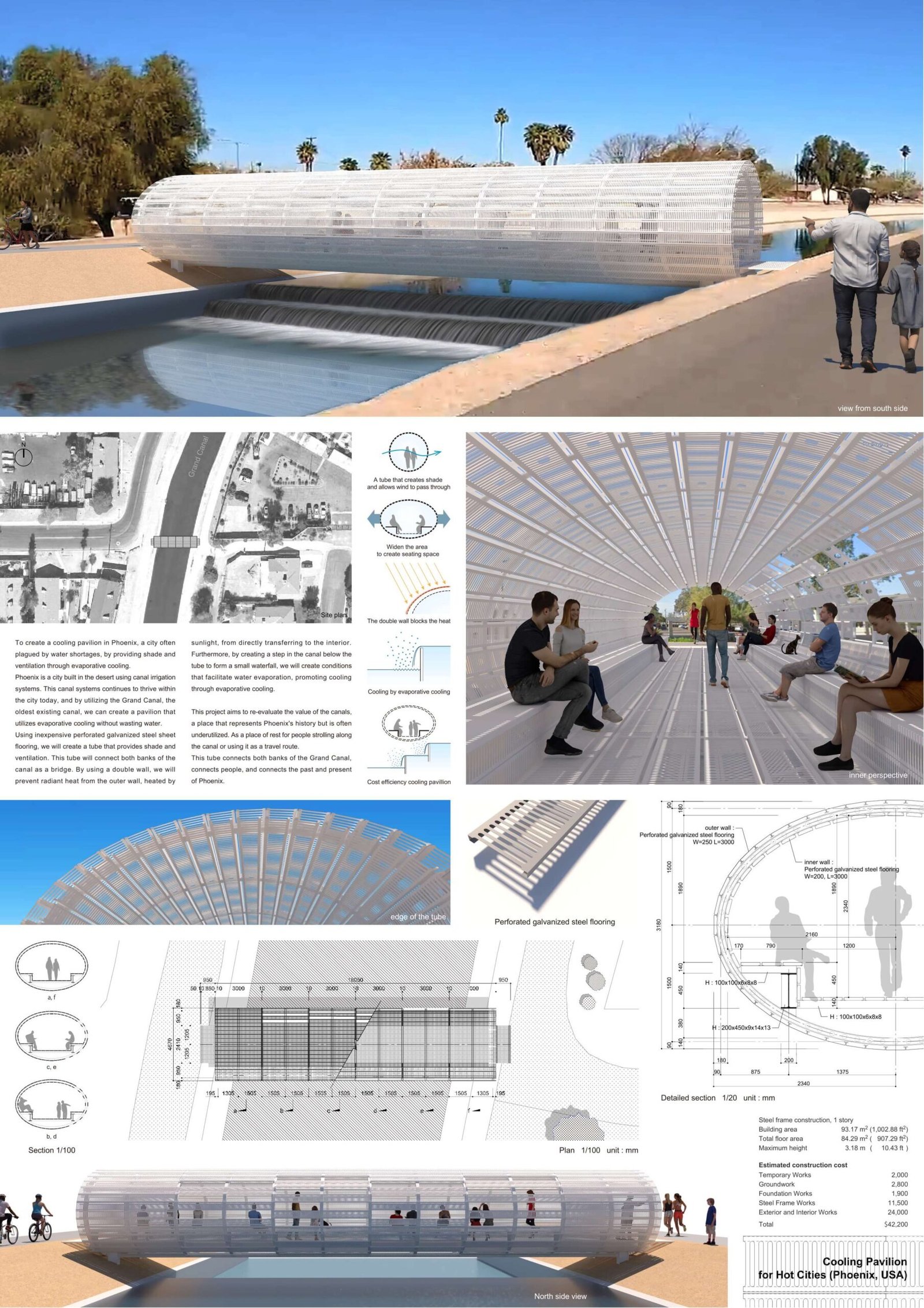
The Winning Story
Phoenix, Arizona is a city that should not exist — at least not in the way it does. Built in the heart of the Sonoran Desert, it survives on a fragile bargain with water: ancient canal systems, engineered over centuries, that pull life from distant rivers and deliver it through the city’s veins. But in a place where temperatures regularly exceed 110°F and drought is a permanent condition, the question of how to cool public space without wasting water is not just a design problem. It is a moral one.
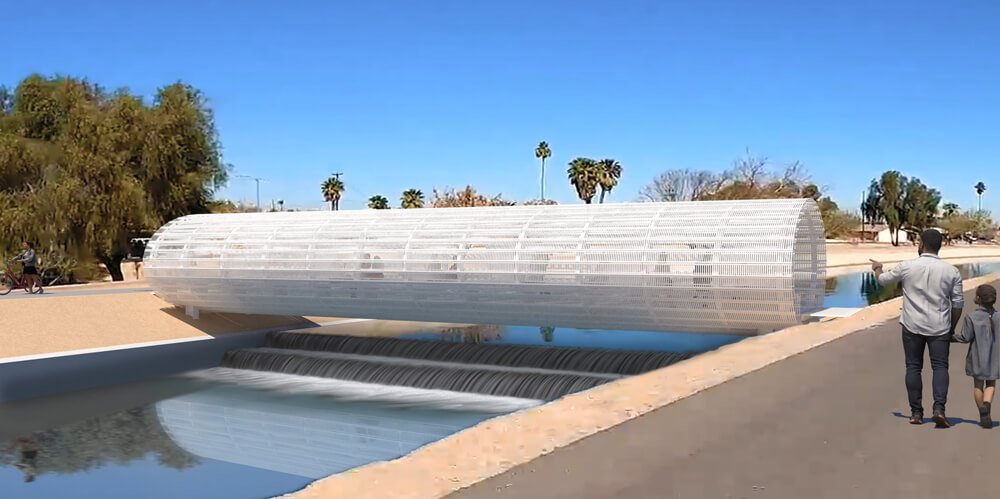
Takehiro Muramatsu, a designer from Japan, understood this immediately. His Runner-Up entry in the Cooling Pavilion for Hot Cities (Phoenix, USA) competition doesn’t fight the desert. It doesn’t import a tropical oasis. Instead, it returns to the city’s oldest piece of infrastructure — the Grand Canal — and asks a simple question: What if the canal itself could cool us?
The answer is a perforated steel tube, a small waterfall, and a lesson in restraint.
The Site: Phoenix’s Forgotten Lifeline
Phoenix is a city built on canals. The Hohokam people dug the first irrigation channels here over a thousand years ago. Modern Phoenix inherited that logic — the Grand Canal is the oldest surviving canal in the city, still flowing, still vital, but largely overlooked. It runs through neighborhoods as a functional ditch rather than a civic space.
Muramatsu saw the canal not as a relic but as a cooling engine waiting to be used.
“By utilizing the Grand Canal, the oldest existing canal, we can create a pavilion that utilizes evaporative cooling without wasting water.”
The Design: A Tube That Breathes
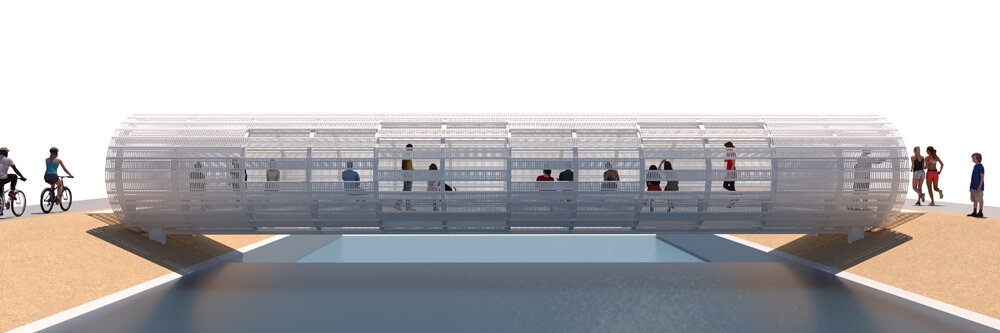
The pavilion is a tube bridge — a single-story steel frame structure spanning approximately 93.17 m², connecting both banks of the Grand Canal. It is built from inexpensive perforated galvanized steel sheet flooring, a material chosen for cost-efficiency, durability, and its ability to let air move freely.
But the real intelligence is in the double-wall design:
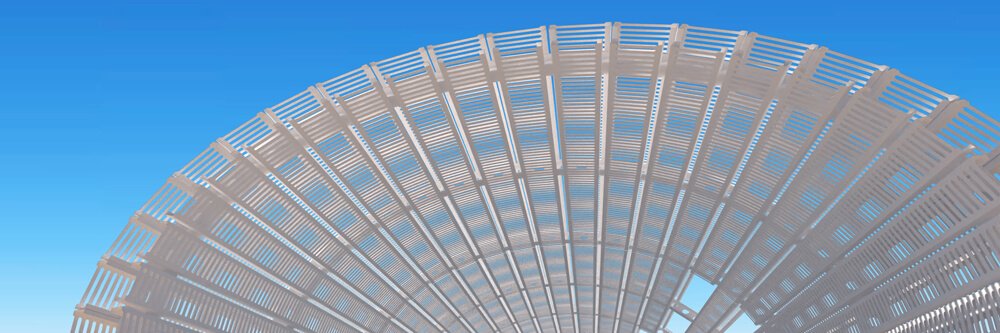
- Outer wall — absorbs the brutal Phoenix sun, heating up so the interior doesn’t have to
- Inner wall — stays cool, blocks radiant heat transfer, and defines the shaded interior
- Perforations — allow natural ventilation to pass through, creating continuous airflow
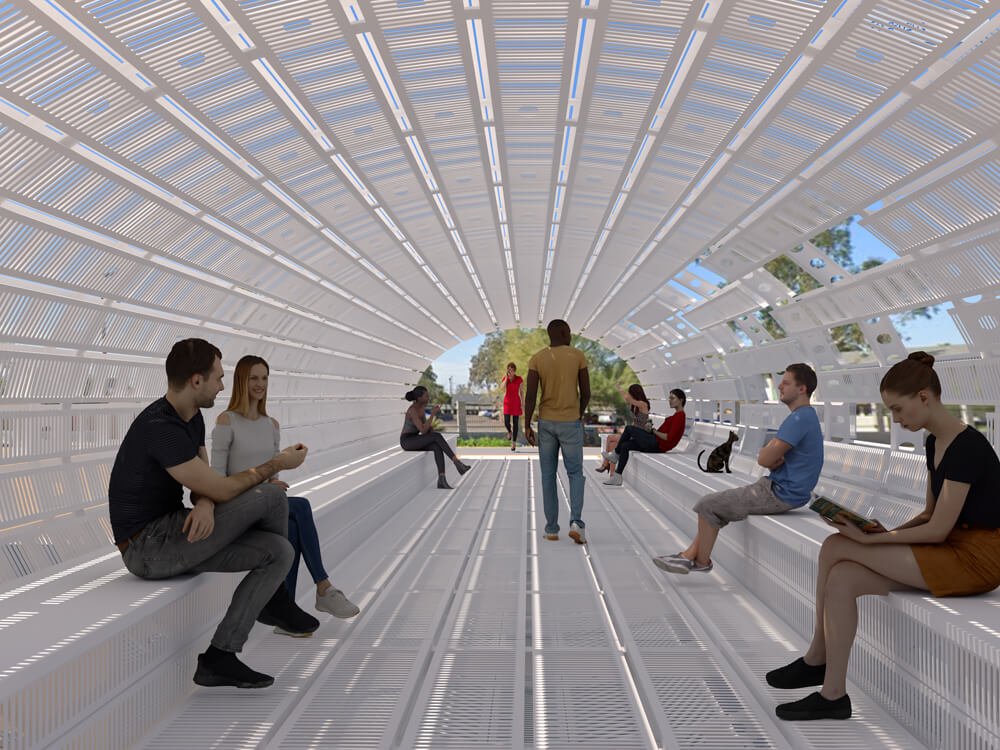
The tube provides shade. The shade provides relief. The airflow provides comfort. No mechanical cooling. No energy-hungry systems.
The Waterfall Trick: Evaporative Cooling Without Waste
Here is where the design becomes genuinely clever. Below the tube, Muramatsu introduces a step in the canal — a subtle change in elevation that creates a small waterfall. As water tumbles over the step, it breaks into droplets, exposing more surface area to the hot, dry air. Evaporation happens naturally. The air cools.
And critically — the water is not wasted. It remains in the canal, continuing its journey downstream. The cooling is a byproduct of the canal’s existing flow, not a drain on the city’s supply.
“By creating a step in the canal below the tube to form a small waterfall, we will create conditions that facilitate water evaporation, promoting cooling through evaporative cooling.”
This is passive cooling at its most elegant: using the physics of the desert — hot air, dry conditions, moving water — to create comfort without consumption.
A Bridge Between Past and Present
The tube does more than cool. It connects.
It spans the canal, linking two banks that were previously separate. It creates a place of rest for people strolling along the canal or using it as a travel route. It transforms an underutilized piece of infrastructure into a hub of community life.
“This tube connects both banks of the Grand Canal, connects people, and connects the past and present of Phoenix.”
The Grand Canal is no longer just a channel for water. It becomes a channel for people — a cooling corridor in a heating city.
The Winner
Takehiro Muramatsu won Runner-Up by refusing the spectacle. His pavilion is not a landmark. It is not a monument. It is a tube, a step, and a breeze — three simple moves that address one of the most urgent questions in contemporary architecture: How do we make cities livable as the planet heats up?
His answer: use what is already there. The canal. The wind. The sun. The water. Don’t waste. Don’t fight. Just listen — and build a tube that lets the desert cool itself.
Team
Takehiro Muramatsu

Runner-Up — Cooling Pavilion for Hot Cities (Phoenix, USA) Architecture Competition
Entry: Team 4365
Explore the competition: Cooling Pavilion for Hot Cities — ArchiBriefer